Sunday, December 22, 2013

CN's Christmas Train - 1984

It was the night before Christmas, and all through the house
Not a creature was sleeping, not even the .... mouse?

I had worked on the spareboard the whole year through,
Rolling up the miles, like all good hoggers do.
 
All my vacation time used up, I had no paid days remaining.
The family was packing, suitcases were straining.
 
Warm socks and sweaters, mittens and slacks.
Our plans were all made; there were no cracks.

I had worked extra shifts, racking up the miles.
We were going away for Christmas.  Look at those smiles!
 
We gather for dinner, excited at last,
For tomorrow we leave, not driving too fast.
 
Granny's for Christmas, it's been our plan all year.
Kelowna's our goal, the road's good, I hear.
 
One more night and we'll be away for a week.
So, off to bed kids!  Have a good sleep.
 
We want to leave early..., get a jump on the crowd.
What's this? The phone is ringing; it's ever so loud. 
 
'Tis time for the 'Board Change'. But I have  nothing to fear.
For I have my miles in. I've put in my time for the year.
 
Should I answer it? It continues to sound.
The crew office perhaps..., I pick it up in one bound.
 
My mileage date is the 28th, and I'm good to that date.
What lies beyond that, I will accept as my fate.
 
Be it spareboard or midnight goat
I'll be the hogger and that's all she wrote.
 
But not just now.  We're off to see Gran.
Gifts are all wrapped. That is the plan
 
That could be the Crew Office calling to tell me I've been bumped off my spareboard job and onto a yard assignment.  I'm not concerned though.  I have my miles in and it won't hurt to take a few days off to spend Christmas with family.

My hunch, based on countless phone calls coming only minutes before the 18:00 cut-off on Friday evenings, the hour of the weekly board change, was correct.   It was the crew office.  I wasn't being bumped...., it was worse!!!

I was being promoted!  One of the engineers assigned to passenger trains 1 & 2 had taken a leave of absence at the last minute, and I was to take his turn for two weeks or more. 

I tried to beg off, but there was no one else available who had been qualified on steam generators.  I tried to get out of it, but when the Assistant Superintendent came on the line, I knew my appeal had hit the wall!

I told him that we had made plans to spend Christmas with family and couldn't change the arrangements we had in place. 

"Just do what you gotta do," he said.

In a flash, the solution came to me.  "... Do what you gotta do...?"

The next day, December 24th, 1984 found me climbing up the side ladder and into the cab of a CNR FP9a on the head end of number 2 in Vancouver, BC.

In the 2nd engineer's seat, Mark Liggins was looking through the pile of train orders, clearances, bulletins and instructions that would cover our movement over BN track to Sapperton, then CP track to Mission, across the Mission Bridge and onto CN track at Matsqui.  After that, we'd be on home territory to Boston Bar.

Passengers are moving up and down the platform, looking for their assigned car numbers; baggage carts are tranferring baggage and express into our head-end cars; trainmen and porters are standing close to their orange stepping boxes, assisting passengers with their onboard luggage.

The carmen call me to ask for a setup and I apply the brakes for our brake test.  Soon, the brake test completed we get the OK to leave Vancouver.  The train is now on it's way to Edmonton, Winnipeg, Toronto and Montreal. 

I had taken the Assistant Superintendent's advice and did what I had to do.  I announced to everyone at the dining room table that our plans had changed and, starting tomorrow, we would spend some of our Christmas Holiday as travellers on the Canadian National Railway's crack 'Holiday' passenger train.  They would get a chance to dine in the fine dining atmosphere of the dining car; would see sights along the way that too few people ever get to see and, would share in an experience at the end of the line that even fewer people could even dream of.   They would spend a night or two sleeping in the bunk house at Boston Bar.  However, because of the change in plans, it was agreed by all, and at the children's request, that the kids would spend Christmas with their father, and would come with us on the New Years run.   We're good to go!

During that two week period, the second engineer, Mark Liggins invited his father to join us on occasion.  Even so, the cab, which had three seats, never seemed to be crowded. 

 
Train Number Three, standing on the main at Boston Bar is waiting for orders which were being changed, due to a minor derailment somewhere to the west.
 Left to right, Bruce, Mark, Susan and Mr. Liggins Sr.
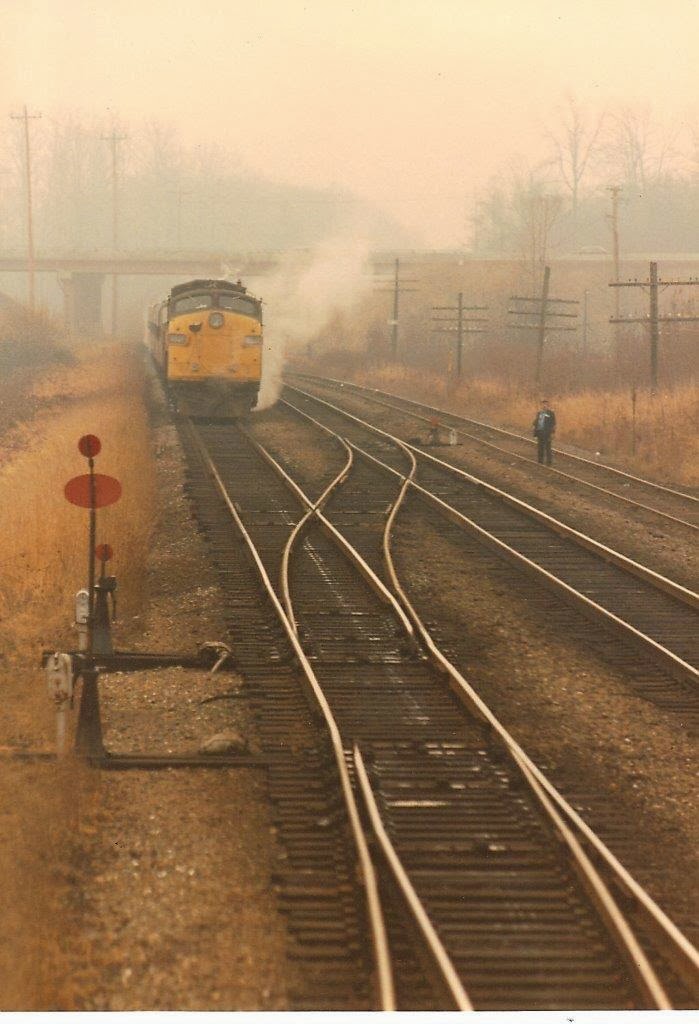

Number Four, meeting Number One at Mission.  Until later modifications were made to the operation, all trains moving over the crossovers west of CP's Mission station were governed by train orders, block indicators and manually operated switches.  Later developments saw the installation of CTC signals and powered, remotely controlled switches.   Here, our head end brakeman, Lorne, walked up and checked the block indicators, lined the switches and gave us a proceed signal by hand when everything was ready for the train to move westward.  


 In this photo, Number Four is headed by FP9a 6531.  Note, the strobes on the roof of the cab.  this was an eastern modification, and not often seen in the mountains.
 

Here, Assistant 2nd Engineer-in-training, Susan Harvey is watching for hand signals from the engine watchman who has been filling the engine's water tanks.

The weather had been typical for the south west slope.  It was cool, wet and sometimes foggy.  There were rumours that it could change to snow in a week or so, but for now..., it was to be a wet Christmas. 

On arrival at Boston Bar, the houses above the rail yard were lit up with strings of lights..., white, green, red and blue.  With no traffic on the highway, and only foot traffic on the narrow side-roads, Boston Bar appeared to be hunkered down for a long winter's nap. But, with a large planer mill in operation there, it wouldn't be long before logging trucks, fork lifts and log loaders would be rolling up and down every avenue again. 

But on this night, on Christmas eve, the gentle lights of quiet celebration served up shards of  coloured lights on the snow covered ground.

As we approached the station, bell ringing, the bare incandescent lights that hung under the eaves over the platform created a pool of daylight in the endless darkness.  The baggage cart waited just beyond the express office doors and the lights in the beanery showed up every empty table. 

After spotting the day coaches in front of the station, Mark, Susan and I stepped off onto the platform and walked back to the station where we wished the operator a Merry Christmas.  He told us that we were the only CN crew in town for the night, and the beanery was being held open so we could have dinner before retiring for the night.  Since all of the eating establishments in town were closed for Christmas, we were grateful to CN and the beanery staff for making this service available to us.

Regrettably, I can no longer recall their names, but the man and woman who operated the beanery in those days were fine folks who worked hard to provide good, home-cooked meals on short order and at fair prices. 

When we entered the brightly lit dining area, we found ourselves alone, so chose a table and sat down.  The lady came to our table and told us that we could have whatever we wanted from the menu, at the posted prices; however...., there was a fresh roasted turkey in the kitchen and we were welcome to share in the feast with the staff...., at no charge.  In fact we could eat our fill until midnight and wouldn't have to pay a dime.  And we did.   We had a wonderful dinner, replete with home made half pound butter tarts!!!!

Leaving the beanery, we walked over to the bunkhouse where we found the two storey building lit up, warm, clean and inviting..., but empty.   Therefore, we booked into our rooms and eventually turned in for the night.

Marks father drove to Boston Bar a took Mark home for Christmas, planning to bring him back before train time in the morning.

In 14 days, I made 7 round trips.  On four of those trips, my wife travelled with me. On the New Years trip, the kids came along too.

On the trip prior to New Years Eve, Delores, the woman who was in charge of the bunkhouse told me that the towns-people had invited us to join in the New Years festivities in Boston Bar.   I told her that I was grateful, but that we would have the children with us on that night, so would stay in the bunkhouse.  Delores told me that the ladies were aware of that and had arranged for a baby sitter to be available for us.  Wow!  Thank you Delores, where ever you are.

When we left Vancouver on New Years Evening, Mark was staying in the bunkhouse and he volunteered to keep an eye on the children so that Susan and I could go to the New Years Eve dance at the community center.

It had been snowing hard all day and the news was getting worse with each passing hour.  Only the passenger trains were being kept moving.  The highway was closed both east and west of Boston Bar.  

With driving snow skidding over growing drifts, we set out from the bunkhouse and turned up the hill toward the community center.  After only a couple of hundred feet of plowing through the drifing snow, we heard the voice of a man calling out to us.  Standing in the open doorway of a nearby house was Phil Moreau, one of the CN operators.  He waved to us and invited us in for an appy.  We were happy to join Phil and his lady for a visit.   When we got inside their house, we saw that they were prepared for a much larger party, but we were the only ones there.  Phil said that they had planned their New Years Eve party for months and were to be joined by friends who would drive in from Kamloops and beyond.  The snowstorm now in progress had changed their plans.  No one was coming and the table and sideboards were heavily laden with goodies.  We thought we would be doing a good turn by staying to ring in the New Year with Phil and his lady.

The next morning, with snow still falling heavily, we set out on Number 1.  With the train drifting lazily down the gentle grade out of Boston Bar, and large snowflakes seemingly hanging in the air, we listened to the thrumming of the 567's, easy exhaust sounds and steam escaping from uncountable leaks and vents.

By the time we left Yale, 27 miles from Boston Bar, Mark, Susan and I had been joined by a variety of senior CN officers who were enjoying a mid-winter break, coupled with a head-end ride on the old FP9's.   Lorne had brought them up from the coaches, and he also brought tall, strong coffees and warm muffins for the engineers.  He knew that I could use one after last night's revelry at Phil's house.  Thanks Lorne.

None of them questioned the presence of my wife in the cab and I wasn't concerned that they might.

After all, I was just obeying an order from my Assistant Superintendent when he said that I must "do what you gotta do."

There have been a lot of changes since 1984.  The FP9's don't pull passenger trains on CN main lines any more.  Stations and their beaneries have vanished, passenger service in Canada has nearly gone the way of the dinosaurs.  But, for now, and at least for the foreseeable future we still have Christmas, the winter Solstice and the new year.

Thank you, good friends, for sharing with each other throughout the year.  And thank you for reading Caboose Coffee's stories, which are my gift to you.

In closing, please accept my humble offering of a wish for a very Merry Christmas and Happy New Year.

NOTE:

Mark Liggins sent an email with his recollections of our time together on the passenger train (backed up by his trip notes of the day).  I added his email to this blog in the "comments" section, below. 


Thursday, October 31, 2013

A Work of Art, Hidden Behind a Work of Art

There were many things I liked about our new house.  It was built on a quiet street where we could play we could play without having to worry about big dump trucks rumbling by, dropping iron ore pellets that rolled along the pavement, until they ended up at the edge of the road.  The dump trucks weren't actually an unwelcome site for little boys because with only a jack knife, we made sling shots from a branch with a natural crotch in it, cut from our sour cherry tree, a couple of strips of rubber from a discarded truck-tire innertube that Mr. Hanzel, our neighbor had brought from the shop where he worked, and a bit of old harness leather that Donnie Lemieux's grandfather had discarded.  A little trimming, cutting, scraping and whittling, and we had truly fine slingshots.  The iron ore pellets that fell from the dump trucks were ideal for use with a slingshot since they were round, like a glass marble, would fly true when released and...., they were free.

That was our old house on Sellwood Road.

Our new house was built on Vaughn Street.  Our lot was small, and so was our house.  But the lot backed onto a low, wide swampy area that carried a slow moving creek from a great, marshy pond on the north side of the tracks at mile 144 on the Alderdale sub.  The creek eventually disappeared into a culvert that drained into the Vermillion River way across town, beyond the YMCA which had bowling alleys and pool tables..., way beyond the Fire Hall and the town jail, which I spent a whole day in...., way beyond Nepitt's General Store where I bought snare wire and .22 shells to take out into the bush with my dog, Roxy. 

In the summer, 'the swamp', as we referred to it, was a wonderful place to spend the day.  The Tea Bush grew to four feet in height and the bull rushes grew much taller than that.  There were frogs and snakes, turtles and bitterns, blue herons, hawks and a great many small birds which nested there. 

Freddy Lammi had a young crow that he had tamed and he would proudly walk past my house with the crow on his shoulder.  I wanted a pet crow too, but couldn't find a nest to take one from. I would find, occasionally, a baby robin or blackbird, but was never successful in raising one to an adult.

One of the best things about living in Capreol, and in particular, on Vaughn Street, was the proximity to the railroad line.  If I walked down to the east end of the street, past Mike Corrigan's house, I could quickly cut through the bush on a well worn trail that ended at the beaver pond where a colony of beavers had built and maintained a typical beaver dam all the way across the low valley, creating a large, deep pond with a big beaver house in the deepest part. 

The beaver dam served as a great place for us to cross the swamp without getting wet, unless of course a mis-step caused me to slip into the water, filling one or both of my rubber boots with water.

In the winter, the beaver pond was a popular place to gather for game of hockey among friends.  I know..., you've heard this before, but it's true.  Back in the day....., winters were a lot longer and a lot colder, or more severe than they seem to be now.  Even tho' the temperatures would plummet to minus twenty five and stay there for weeks on end, it didn't prevent us from having fun outdoors.  There were hills to take our toboggans to, ice fishing, snow shoeing, playing hockey on the many backyard ice rinks that were made to provide kids with a place to play.

The only window in my tiny bedroom in our new house faced the creek, the swamp and the final three hundred yards of the CNR Alderdale sub.  I loved to watch eastbound trains leaving town and westbound trains arriving from Ottawa and Montreal.  They moved very slowly past my window because they were either leaving or entering the yard.  In either case, the trains pulled past the curling rink, the stock pens and the beaver pond, and I had an unobstructed view of some of the most awesome sights a little boy growing up in a railroad family could hope for. 

These were the final days of the steam locomotives.  More and more freight and passenger trains were being pulled by the non-descript, monotonous diesels with the strange sounding horns.  They didn't seem to have any moving parts and they looked much the same, whether moving forward or backward.  I found myself turning away from trains that had a diesel on the head end.

One such cold, winter night, I had gone outside after supper to lie on my back in the front yard to watch the Northern Lights dancing overhead.  I was dressed warmly and was able to lie there for quite a while without feeling any cold whatsoever. 


The moon had risen over the quiet little town, making the recently fallen snow appear to sparkle with the dust of billions of tiny diamonds in shades of blue, white, red and green.  There wasn't a whisper of wind, or any air movement and from every chimney, smoke slowly rose into the crisp night sky, hanging there, as if frozen until spring would come to release it from winter's icy grip.

I got up, brushed myself off and went to the kitchen door to be helped out of my winter clothes so I could go to bed.  Dad would be coming in off the road sometime in the night and, after he had some rest, he had promised to take us all to the lake for a day of tobogganing and dinner cooked over an open fire.  My mom and sister hadn't shown much enthusiasm for that idea, but I would work on them.

A cup of warm milk and I was tucked into my bed to wait for sleep to come.  As my eyes grew heavier, watched the bright moonlight play on the thick frost that had formed on my bedroom window.  I marvelled at the intricate designs that nature created each night on my window...., never painting the same thing twice.

In the morning, I woke to the sound of a steam whistle that I didn't recognize.  I can't describe it, other than to say that it was different from that of a Mikado, a Northern, or a Mountain.  It was deep, but with a sharp, crisp beginning and end, followed by that beautiful 'quilling' that always gave me goose-bumps.  It sounded something like a trumpet that was being played like a trombone.


Scrambling from beneath my covers, I tried to open my window for a look at this locomotive before it disappeared from view.  The window was frozen shut.  I guess all wood frame sash windows were left closed each winter for the same reason that mine was closed.  Ice.


I could hear the soft 'chuff' coming from the stack and knew that it was now directly behind the house.  It would be gone in a moment!  I placed my palms against the glass, which was covered with a deep layer of Jack Frost's most beautiful work.  I held them there until I could feel the smooth, flat glass beneath my hands.   Then I lifted them away, sticking them deep into my warm blankets.


I looked throught the holes in the ice that my warm hands had made. 

There, arriving from Ottawa on the head end of the morning passenger train, was perhaps the most stunning, unusual steam engine I had ever seen.  I did a double-take, looking at it very carefully, as it passed in and out of the clouds of steam that it was creating around itself. 

It was black..., and green.  It had a Vanderbilt tender, but it wasn't like any Vanderbilt tender I had ever seen.  On the tender was the round CNR Maple Leaf wafer that said it was one of ours, and it was a passenger engine.  And the wheels, they really couldn't be that tall!!!  And there were only six of them! 

It was beautiful and I knew at that moment that, not only did I want to see this machine up close, but I wanted to be a locomotive engineer and run it on the head end of the passenger train.

As it disappeared into the frosty haze that had settled on the town, I leaped from my bed and ran to my parent's bedroom.  Mom was having her coffee in the kitchen and she started to tell me not to wake dad, because he needed his rest, but.......,

Jumping on the bed, I urged him to get out of bed so we could go down to the station and see the new steam locomotive that had just arrived.  I was sure it was going to leave on the Ruel sub for Foleyet and Hornepayne in a few minutes and we should hurry if we want to catch it.

I'm sure that if it had been for any other reason than to see a new steam engine before it left town, he would have had a much different message for me when I 'yanked' him out of his deep sleep.

We scrambled to get dressed and, still doing up buttons on our coats, we went out into the cold morning air. 

"We don't have much time," he said,  "if we walk to the station, we may be too late."

"We have to take the car," I said.

He took the keys from his coat pocket and with some difficulty due to the locks being frozen, he got the front doors opened.  It took a lot longer to actually get the doors opened, as the rubber door seals  had frozen together. 

I suggested pulling until they separated, but Dad didn't want to do that, saying that the seals would be badly torn if we pulled on them.  Getting them to release seemed to take forever, but eventually, we got the drivers door open and we both slid in on the frozen seat cover. 

With fingers crossed, I watched as he put the key in the ignition, stamped on the gas pedal a couple of times and turned the key.  The block warmer had done its job and the engine turned over, catching after several seconds of cranking. 

With the defroster blowers on full, we backed out of the driveway and headed for the CNR station, the rubber tires thumping with every revolution.  Until we had driven the car for a couple of miles, the flat spots in the tires that had been next to the ground would remain as flat spots, causing the car to thump as it travelled down the road.

After ten minutes, we arrived at the station and parked the car.  Dad and I went into the yard office where he checked the train register to see what engine would be used to take the passenger west of Capreol.  Apparently, it wasn't the one we were looking for, because I overheard someone in the office say that "motive power wants it back right away."  It had been sent to the roundhouse for trip service and was to be run south to Toronto as soon as possible.

Dad, believing that we had lots of time, got into a long conversation with a small group of rail men while I hovered near the hot water radiator that stood near the table where the operating bulletins were kept.

Finally, we left the yard office and got into the car.  I thought that we should walk from the station, across the yard and westward along the shop service tracks to the roundhouse, but Dad wanted to keep the car handy, so we drove. 

After making a five-minute stop at the post office, we again carried on toward the shops.  Well, not exactly.  In order to get to the shops and the roundhouse, we had to back track almost all the way back to our house, then turn north, then east and then west; in effect, we had to drive almost the entire circumference of the town before we could get to the employee parking at the back of the roundhouse.

Young street, the main thoroughfare through the downtown business core would eventually end at Dennie Street which was an extension of highway 69 south, becoming Selwood Road which would eventually get us to the shops.

The Sudbury sub, or Bala sub crossed Young street in order to move trains to or from Toronto, and we sat for twenty minutes while a long northbound freight slowly made its way into the yard, blocking the crossing, thus allowing the mystery steam engine time to escape.

The moment the caboose finally tip-toed across the road, we were off!   A left on Dennie Street and soon we'd be on Selwood Road, driving past our old  house and on our way to the shops.

Nope.  The Alderdale sub crossed Dennie Street and runs eastward between the beaver pond and the curling rink.  There was a short eastbound freight already on the crossing, it's head end having disappeared in the clouds of steam that escaped from around the cylinders, beneath the cab, from the tender and from the stack. 

The caboose was soon out of the yard and 'on the high iron'; we once again headed for the shops to get up close to the steam engine I had seen from my bedroom window a couple of hours earlier.

I was beside myself with excitement, but couldn't get past the feeling that we had taken too long to get there.  The dark, steamy cavern that was the roundhouse seemed to be hiding my prey from my eyes.  Looking left and right, I saw only locomotives that were familiar to me. There was a small switcher with footboards, a couple of large-boilered engines with huge Elesco feedwater heaters hung over their smoke box doors.  These looked like an afterthought, because they had to mount the tri-angular number boards above the feedwater heater bundles, there not being enough room to put them below, due to the headlight placement. 

But, I couldn't see anything that looked like the one I caught a glimpse of through the little hole in the ice on my window.


Once inside, dad took me to the shop foreman's office, where he looked at the big board on which hung tags with the names of every fireman, hostler and engineer in the whole terminal, showing their status on the working board.  Some were booked off, others were waiting a call, and some were out on the road, or working a yard engine or snow plow.

Dad and the shop foreman spoke softly for a moment or two; then Dad turned to me and said..., "we missed him."  "He was on the eastbound we waited for by the curling rink."  "I've asked the foreman to keep an eye out for one of those engines for us, but he says that it was a rare sighting and even he didn't get a chance to have a look at it." 

It had been serviced and turned on the big turntable.  A crew had been called and was ready to take the engine to the yard to connect with an eastbound speed.  The turnover had taken less than 30 minutes.

The engine.....,  it was one of those beautiful racehorses of the steam era... a CNR K-5a Hudson.

I have never seen the real thing, but I have a wonderful, painted model of it on display where it reminds me of a cold winter morning chasing trains with my Dad, so long ago.

Thursday, August 29, 2013

And now, a message from our sponsor.

Life has been quite hectic around the Caboose Coffee ranch for a couple of months.   While most of you come to this site to read authentic railroad stories, and I come here to write them..., the stories don't put new shoes on my grandson.., or myself, for that matter.  So, I've been focusing on my internet hobby shop, http://caboosecoffeehobbies.blogspot.ca/.  We've recently been asked to sell a substantial collection of mostly HO scale brass locomotives, cabooses, passenger cars and maintenance of way cars.  There are CP, CN, GN, BN, BC Rail, logging and others in the collection.
I've set up separate "pages" for each of the railroads' engines and rolling stock, so look for the tabs near the top of the home page and scroll down through the models that are posted there.  The collection is made up of over a hundred models, so bookmark the site and check back now and then to see what's new.  Or, you can write for a list of the models and their prices.

As for pricing, I've used a number of sources to determine a base-line for each model, but the market will determine final price.  If you see something you'd like to have, and feel the price is too high, don't hesitate to make an offer on it, and we'll figure out a reasonable compromise.

We're gearing up for the annual Victoria Model Show on September 8th and will be back with a new story after the show.   If you're going to be in our neighborhood during the show, be sure to drop by our booth and say hello.  Bruce, Susan and Colin will be there to help you find what you're looking for. 
 
Victoria Model Show 2013
Sunday - September 8, 2013

Juan de Fuca Recreation Centre, 1767 Island Highway, Colwood
Free Parking
BC Transit Bus Routes #50

10:00 a.m. to 4:00 p.m.
Operating Model railroad Layouts, Vendors, Swap Tables.

Admisions:
Family - $ 6.00
Adult - $ 12.00
Youth (11-16) - $ 3.00
Children (8 and under) - Free when accompanied by an Adult.

For information and table rentals contact:,br> Ted Alexis (250)595-4070

Supporters of C-Fax Santa's Anonymous, the Times Colonist Christmas Fund